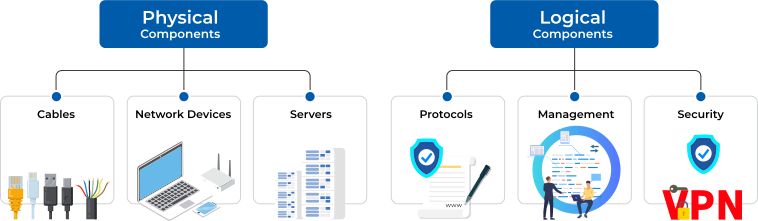
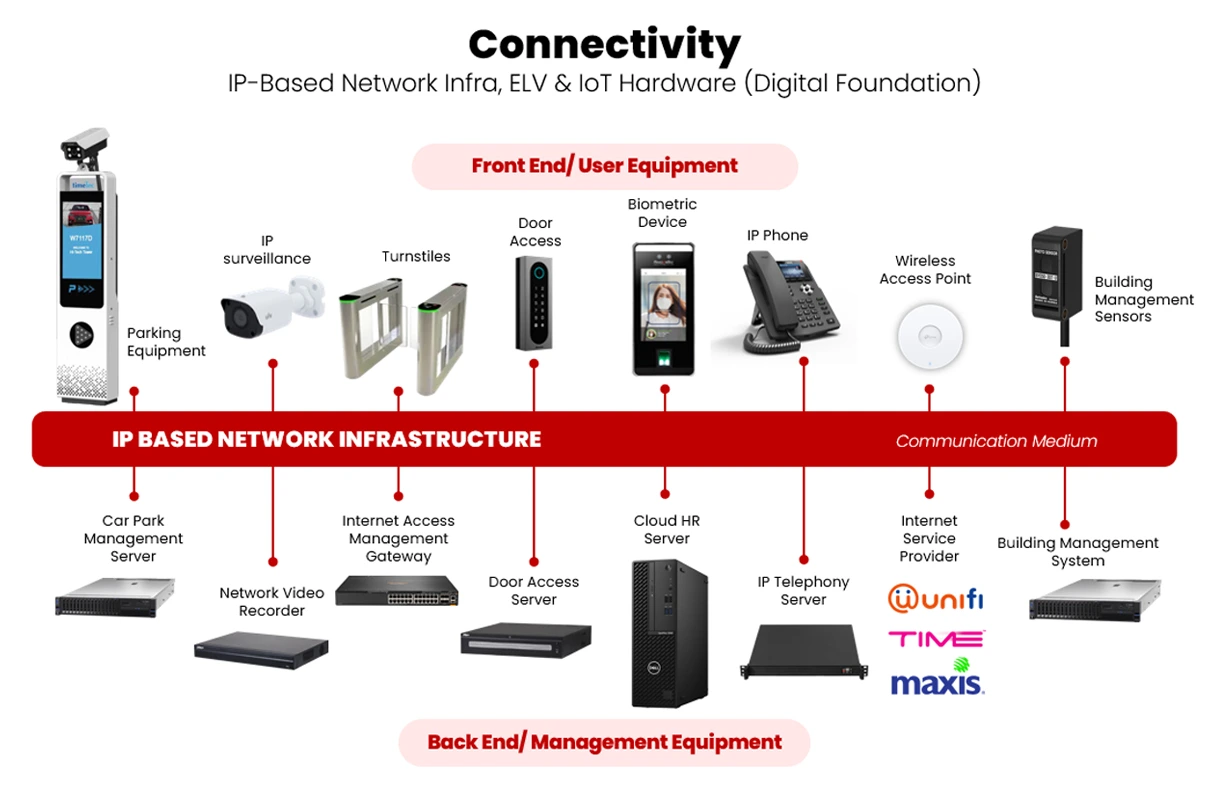
TimeTec offers complete Network Infrastructure solutions alongside our comprehensive PropTech ecosystem, delivering seamless connectivity to support smart building operations. From structured cabling to high-performance network equipment, our infrastructure services are designed to integrate flawlessly with TimeTec’s PropTech solutions—including smart access and elevator control, ELV & IoT automation, smart cashless and touchless parking, visitor management and etc., ensuring a reliable, scalable, and future-ready environment for modern commercial and residential buildings.
What Is a Well-Designed Network Infrastructure?
A well-designed network infrastructure is essential for any organization that relies on technology to operate effectively. It provides the foundation for integrating emerging technologies and new applications, allowing businesses to remain agile, up-to-date, and competitive in their industries.
For service providers, building a robust network infrastructure means ensuring scalability, high availability, and intelligent load balancing. These elements are critical to maintaining seamless connectivity and reliable system performance—key factors in today’s fast-paced digital environment.
Since network interruptions can never be entirely avoided, it's also vital to adopt streamlined network architectures and automated management tools. These help network administrators quickly identify, isolate, and resolve issues, minimizing downtime and ensuring optimal network functionality.
<vcpu placement='static'>8</vcpu> <cputune> <vcpupin vcpu='0' cpuset='2'/> <vcpupin vcpu='1' cpuset='3'/> </cputune> For the log partition (separate disk if possible), set cache='none' and aio='native' to bypass host page cache, reducing latency. 4. Network Multiqueue Enable multiple network queues to distribute traffic across vCPUs:
<os> <boot dev='hd'/> </os> Cause : The qcow2 file resides on a storage pool with CoW enabled on the host filesystem (e.g., Btrfs or ZFS without tuning). Fix : Disable copy-on-write on the host directory for the qcow2 file:
In the rapidly evolving landscape of network security, centralized management is not a luxury—it is a necessity. For organizations leveraging Palo Alto Networks firewalls, Panorama serves as the command center. However, as infrastructures shift toward virtualization and private clouds, the method of deploying this critical management appliance has changed. Enter the file: panorama-kvm-10.0.4.qcow2 .
qemu-img create -f qcow2 -b panorama-kvm-10.0.4.qcow2 panorama-test-staging.qcow2 This clone uses less than 1 GB of disk while sharing the original 100+ GB base image. Even with a perfect .qcow2 file, problems can arise. Here are solutions for frequent pitfalls: Symptom: "Boot Failed: Not a bootable disk" Cause : KVM attempts to boot via network or wrong disk bus. Fix : Ensure the disk is set to bus='virtio' and the boot order is explicitly set:
sha256sum panorama-kvm-10.0.4.qcow2 Move the file to the default KVM storage pool:
virsh snapshot-create-as panorama-10-0-4 pre-upgrade \ --disk-only --atomic --quiesce This creates a new qcow2 overlay file while preserving the original panorama-kvm-10.0.4.qcow2 as a read-only backing file. If the upgrade fails, you can revert in seconds. Need a test instance? Use qemu-img to create a linked clone:
Panorama-kvm-10.0.4.qcow2 File
<vcpu placement='static'>8</vcpu> <cputune> <vcpupin vcpu='0' cpuset='2'/> <vcpupin vcpu='1' cpuset='3'/> </cputune> For the log partition (separate disk if possible), set cache='none' and aio='native' to bypass host page cache, reducing latency. 4. Network Multiqueue Enable multiple network queues to distribute traffic across vCPUs:
<os> <boot dev='hd'/> </os> Cause : The qcow2 file resides on a storage pool with CoW enabled on the host filesystem (e.g., Btrfs or ZFS without tuning). Fix : Disable copy-on-write on the host directory for the qcow2 file: panorama-kvm-10.0.4.qcow2
In the rapidly evolving landscape of network security, centralized management is not a luxury—it is a necessity. For organizations leveraging Palo Alto Networks firewalls, Panorama serves as the command center. However, as infrastructures shift toward virtualization and private clouds, the method of deploying this critical management appliance has changed. Enter the file: panorama-kvm-10.0.4.qcow2 . Fix : Disable copy-on-write on the host directory
qemu-img create -f qcow2 -b panorama-kvm-10.0.4.qcow2 panorama-test-staging.qcow2 This clone uses less than 1 GB of disk while sharing the original 100+ GB base image. Even with a perfect .qcow2 file, problems can arise. Here are solutions for frequent pitfalls: Symptom: "Boot Failed: Not a bootable disk" Cause : KVM attempts to boot via network or wrong disk bus. Fix : Ensure the disk is set to bus='virtio' and the boot order is explicitly set: Enter the file: panorama-kvm-10
sha256sum panorama-kvm-10.0.4.qcow2 Move the file to the default KVM storage pool:
virsh snapshot-create-as panorama-10-0-4 pre-upgrade \ --disk-only --atomic --quiesce This creates a new qcow2 overlay file while preserving the original panorama-kvm-10.0.4.qcow2 as a read-only backing file. If the upgrade fails, you can revert in seconds. Need a test instance? Use qemu-img to create a linked clone: